These Portuguese Cartoon Vandals Are Aging Like Expired Milk and Loving Every Second
Germes Gang treats adulthood like a narc at a house party — ignore it long enough and maybe it’ll leave.

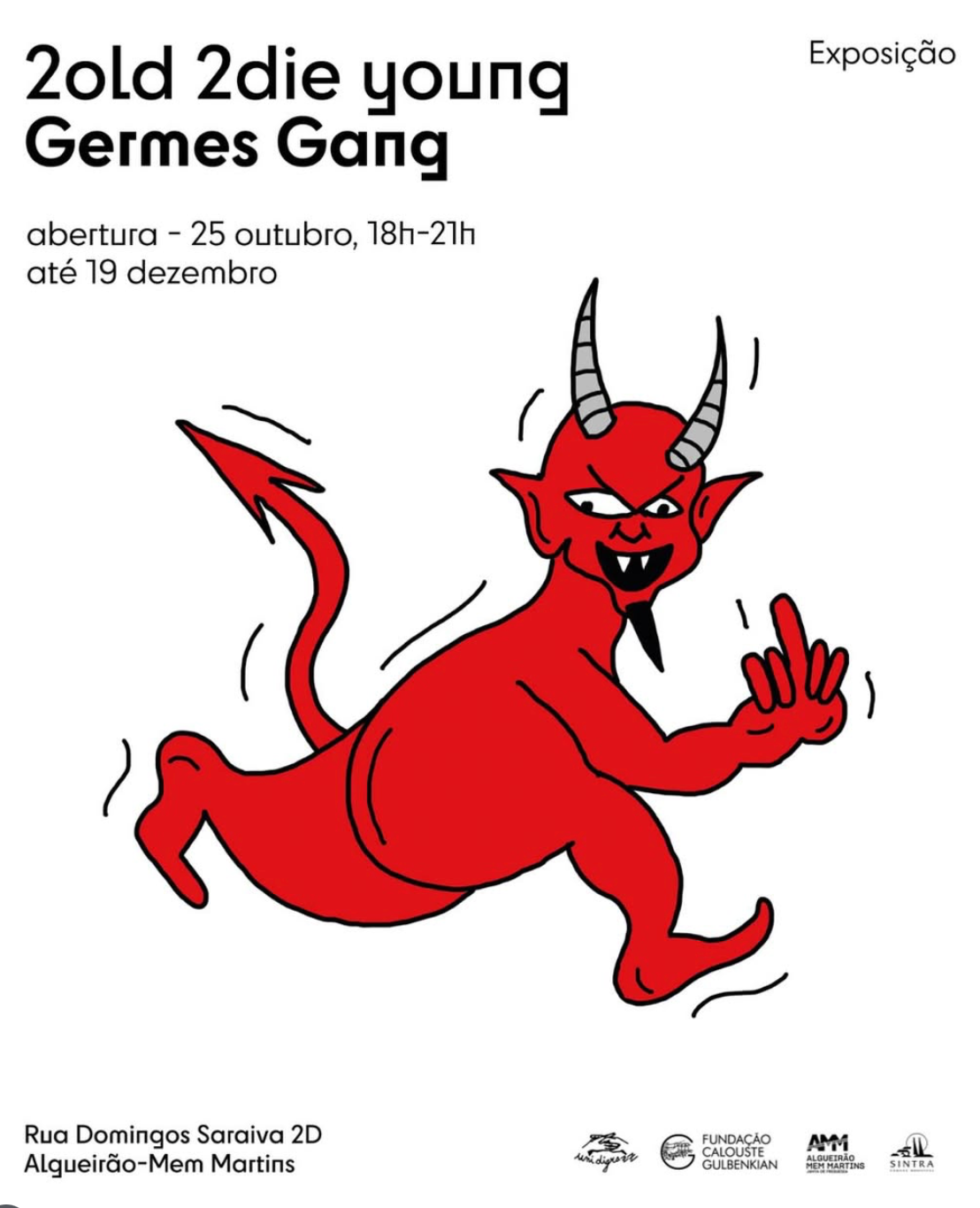
Somewhere between the azulejo saints and the Airbnb plague, a red devil is flipping you off. Not aggressively—more like a tired “fuck this” aimed at nobody and everybody. Welcome to Germes Gang’s Portugal, where growing up is optional and the markers never run dry, they just get expensed.
These are Lisbon’s cartoon arsonists, the illustration crew that treats culture like a piñata full of expired nostalgia and late-capitalism candy. They’re what happens when kids raised on Cartoon Network discover invoicing but refuse to learn maturity. The devil’s been their logo since forever, and he’s not apologizing.
Ren & Stimpy Forever, Unfortunately
Ask them their age and they’ll tell you early-30s “but we feel like 12.” Favorite cartoon as a kid? Ren & Stimpy. Favorite cartoon now? Still Ren & Stimpy. It’s not a bit—it’s the entire ideology. Arrested development as praxis. Their method of survival is to stare at the absurd until it blinks first.
They’ll use anything that bleeds color: acrylic, spray paint, Sharpie, MS Paint, Procreate. High art? Low art? doesn’t matter. What matters is the mark. It’s Nice That once wrote that they “perceive everything related to contemporary life traumatic,” which is half meme, half diagnosis. Their world is populated by pop-culture corpses on day release: Big Bird stalking Lisbon alleys like he’s lost his plug; Homer Simpson realizing he’s a brand mascot for burnout. It’s hilarious until it isn’t, and that’s the trick—they make trauma draw itself in crayon.
The Gods of Anti-Style Have Entered the Chat
Graffiti heads call it anti-style—the school of deliberate wrongness. Germes Gang push it to the brink: melted anatomy, drippy outlines, mutant faces, chaos that still reads as rhythm. A recent video called them “the gods of anti-style,” and for once the internet wasn’t exaggerating. Traditional writers build cathedrals out of lettering; Germes Gang prefer Molotov cocktails shaped like cartoons.
It’s part of a wider continental drift. Across Europe, writers are abandoning formal purity for expressive noise. The lineage runs from Paris to Porto, Berlin to Setúbal. You could call it graffiti’s late-capitalist adolescence—the moment when the form starts talking back to its own nostalgia. For Germes Gang, vandalism isn’t an aesthetic—it’s pedagogy.
2old 2die young (But Definitely Too Weird to Quit)
Their latest show at Ponto Kultural reads like a dare: 2old 2die young.
The curatorial text speaks of “learning, subversion and naivety in the universe of graffiti,” which translates roughly to How do we stay untrainable once people start paying? It’s the eternal tension between play and professionalism—the slow death of rebellion disguised as career growth. The devil on the poster knows that feeling intimately: grinning while the paint dries, middle-finger still raised.
Lisbon’s Cartoon Corruption Ecosystem
Germes Gang isn’t an island. They’re part of Lisbon’s new visual underground, where irony became infrastructure.
Ricardo Passaporte, another alumnus of Portugal’s painter scene, paints supermarket logos like they’re sacred relics, hijacking corporate aesthetics with Pop-nihilist tenderness. In interviews, Passaporte admits he’s “not trying to criticize consumerism but to show how absurdly familiar it’s become.” [VICE Portugal, 2019] That exact tension—affection versus disgust—runs through Germes Gang too.
Meanwhile, Tiago Evangelista’s Barbar pieces take childhood’s soft edges and twist them into existential angst. Together they form an informal micro-movement of Lisbon artists who vandalize nostalgia instead of walls, remixing childhood iconography into sociological evidence.
Portugal’s post-crisis economy incubated this tone: irony as survival instinct, humor as therapy, precarity turned into aesthetic posture. When your rent depends on side hustles and brand collaborations, clowning becomes a political act.
The Secret Weapon Is MS Paint
Part of the charm is how cheap it all looks—and that’s the point. Germes Gang refuses the production gloss that sterilizes “creative industry” art.
Markers, spray, vector lines, pixelated brushes. No mystique, no gatekeeping, no luxury materials—just raw accessibility. The punchline lands instantly; the dread follows later. Plenty of apocalyptic art mistakes despair for depth. Germes Gang chooses absurdity as resistance.
Their interviews are minimal to the point of trolling. Lisbon? “Warm.” Graffiti? “Sympathetic.” Tattoos? “Everywhere.”They speak in emojis before emojis existed. It’s self-protection through sarcasm—an unwillingness to let institutions tax their sincerity. When curators demand statements, they offer cartoons. When critics demand depth, they offer MS Paint. The work handles the philosophy on its own.
Get Fun, Think Mean, Draw Fast, Laugh Last
From street level, Germes Gang’s ethos for 2025 is simple: grow older without growing obedient.
Keep humor radioactive. Let naivety mutate into weapon. Dance with the devil mascot until it feels like cardio.
Because every scene, once successful, gets domesticated—its edges filed off, its spirit sold back to us as merch.
Germes Gang’s refusal to mature is not nostalgia—it’s counter-governance.
As Ricardo Passaporte once said about his own work, “We’re all part of the system; the only rebellion left is to play inside it so hard it breaks.” [Ruttkowski 68 Interview, 2022] Germes Gang understood that before anyone wrote it down.
Their closing mantra still holds:
Get fun. Think mean. Draw fast. Laugh last.
And if adulthood keeps knocking—don’t open the door. Just draw a devil on it.