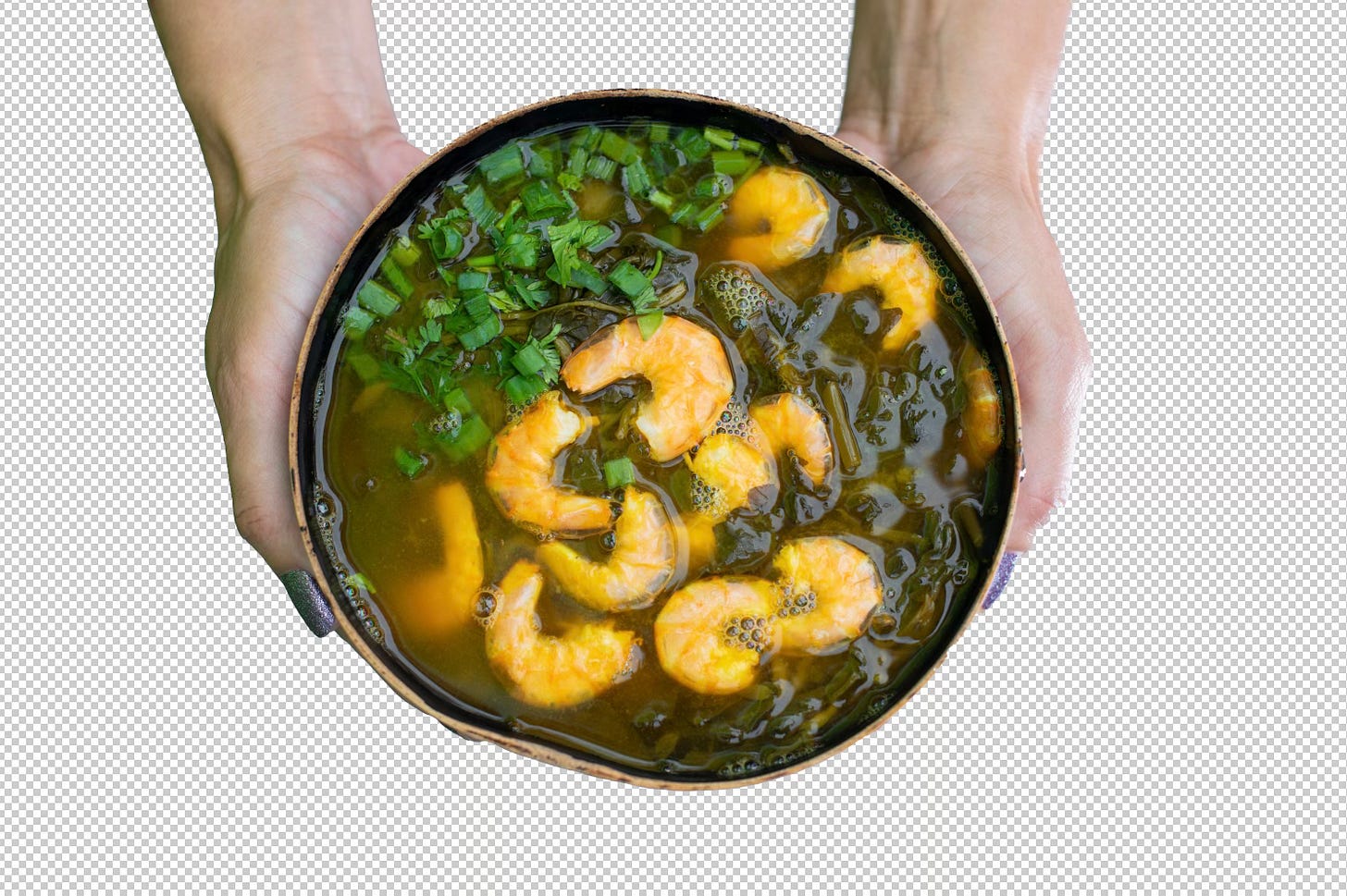
What Happens When Ancestral Street Food Becomes Cultural Heritage?
Follow the Women Who Keep the Amazon Boiling — how Tacacazeiras Just Became Brazil’s Newest Cultural Powerhouse.

Brazil just did something unexpectedly radical: it officially recognized the Tacacazeiras of the North—the women who prepare and sell the Amazon’s most electrifying street food—as national cultural heritage. Not chefs, not restaurants, not some sanitized foodie trend. Women. On the street. Stirring boiling tucupi in plastic bowls.
And honestly? It’s about time.
Because tacacá isn’t just a dish. It’s a cosmic broth of Indigenous science, forest agriculture, female knowledge, and the kind of slow, dangerous, ancestral fermentation that would give any Michelin inspector a panic attack. Tucupi—the wild manioc liquid at the heart of tacacá—is literally poisonous until the tacacazeiras tame it through processes older than colonization. Jambu makes your mouth tingle. The goma thickens like a spell. Shrimp floats like offerings.
Tacacá is not cuisine. It’s cosmology in a bowl.
And for centuries, the keepers of that cosmology have been women—most of them informal workers, holding their stalls together with plastic chairs, thermos flasks, and intergenerational memory. They are living archives disguised as street vendors, standing at the intersection of survival and tradition while the Amazon mutates under climate collapse, agribusiness expansion, floods, and the slow-motion apocalypse of urban “development.”
Now, finally, the state sees them.
But this recognition didn’t fall out of the sky. It took 15 years of pushing, documenting, arguing, and academically proving what every Paraense already knows: tacacazeiras are the Amazon’s original cultural influencers. A 2024 dossier by the Federal University of Western Pará basically performed an x-ray on the tacacá universe—mapping everything from manioc toxicity to community economies to the street choreography of preparing a serving in under 20 seconds.
The bureaucrats nodded. Iphan stamped.
Patrimônio Cultural do Brasil.
Official. Protected. Elevated.
What happens next? A Plano de Salvaguarda, a kind of governmental promise ring: infrastructure upgrades, access to better inputs, cultural promotion, and policies to make sure this ancestral craft doesn’t get swallowed by gentrification or replaced by some influencer selling “tacacá gourmet” in an air-conditioned mall.
Because that’s the real threat—not extinction, but aesthetic gentrification. The Amazon has a long history of having its symbols stolen, sanitized, and resold by people who never smelled tucupi fermenting in their lives. The heritage label is a firewall against that. A legal shield saying: this belongs to them.
Ivanete Pantoja—president of the Tacacazeiras Association—put it simply:
“It’s the legacy of generations of women.”
And there it is. Women who turned toxic roots into nourishment. Who built entire micro-economies before the word “entrepreneur” arrived in the North. Who fed cities before iFood existed. Who carry the forest in their bodies, their voices, their ladles.
Now they carry a title, too.
All hail the tacacazeiras: the queens of tucupi, the guardians of Amazonian fire, and now—finally—Brazil’s newest cultural icons.